In a landmark move to standardize residential renewable energy infrastructure, Zsen Risun Energy Technologies today released its official Home Energy Storage System (HESS) Installation Process Specification, establishing a gold standard for safety, efficiency, and reliability in the rapidly expanding home battery storage sector. The comprehensive 12-step protocol, developed over 18 months in collaboration with the China Electrical Engineering Society and leading fire safety institutions, comes as the country’s residential solar-plus-storage installations are projected to surge 127% year-on-year in 2025, according to the National Energy Administration.
A Response to Industry Urgency
The launch arrives amid growing concerns over inconsistent installation practices, which were linked to 17 reported home battery system incidents in 2024, including 3 thermal runaway events. “As millions of households embrace energy independence, cutting corners on installation isn’t just risky—it’s a ticking time bomb,” said Dr. Mei Ling, Zsen Risun’s Chief Technology Officer, during the press briefing in Shanghai. “Our new protocol isn’t just a set of rules; it’s a promise that every family can adopt clean energy without compromising their safety.”
The specification mandates a rigorous, end-to-end workflow that prioritizes risk mitigation at every stage, from pre-installation site assessment to post-commissioning performance validation.
Step-by-Step: The Zsen Risun Installation Framework
1. Pre-Installation Site Assessment & Documentation
Before any tools are unpacked, certified technicians conduct a 45-point inspection of the property’s electrical infrastructure. This includes verifying the main distribution board’s load capacity, evaluating ambient temperature and humidity levels, and assessing structural integrity for wall-mounted systems. Technicians must also document the home’s historical energy consumption patterns using Zsen Risun’s proprietary Smart Metering Tool, ensuring the system is sized to meet both daily needs and backup power requirements during outages.
2. Personal Protective Equipment (PPE) Mandate
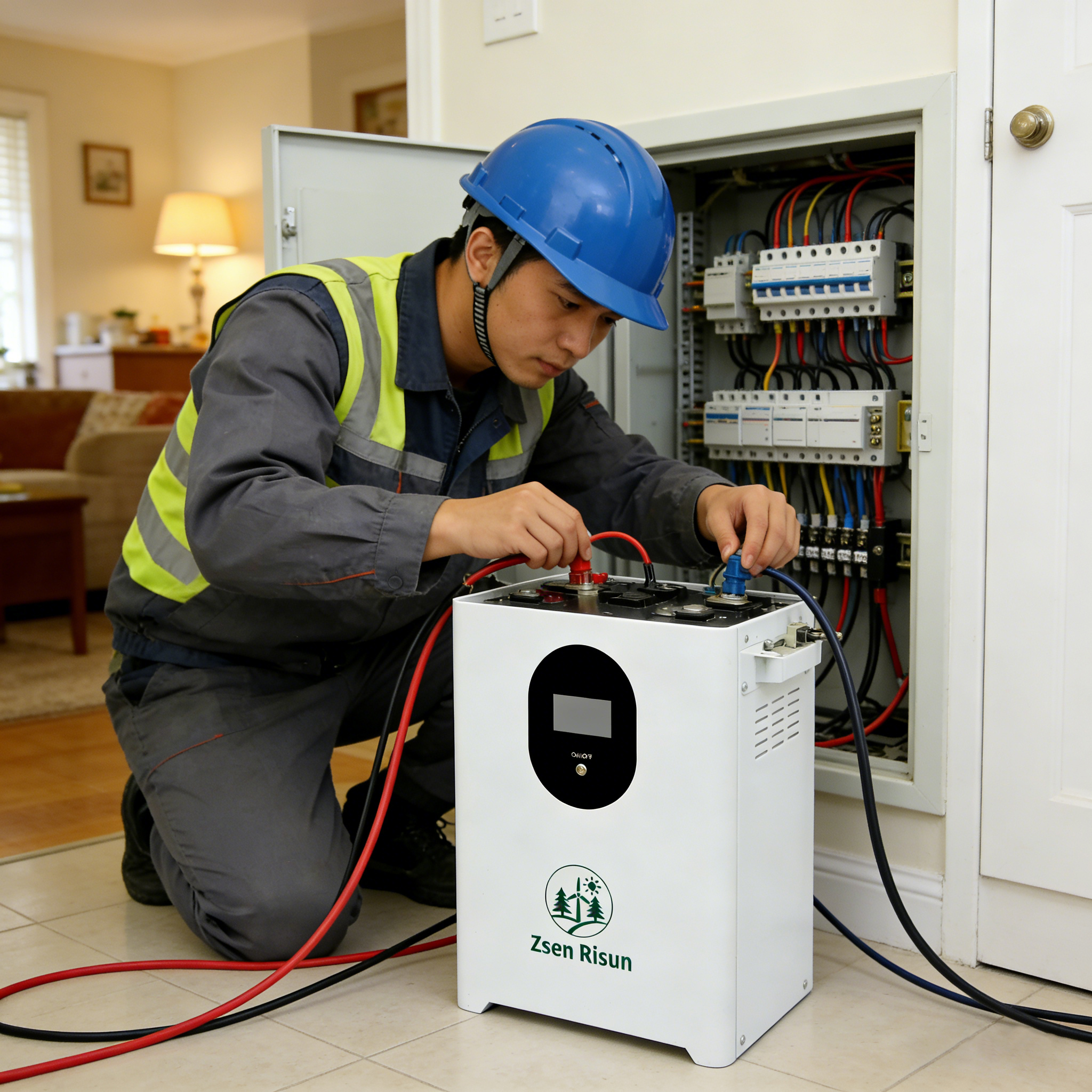
As illustrated in the company’s official training imagery, technicians are required to wear Category 2 arc flash PPE, including a Class E hard hat, flame-resistant coveralls, and voltage-insulating gloves rated for 1,000V AC. “We’ve integrated PPE checks into our digital checklist—technicians can’t proceed to the next step unless their safety gear is verified via our mobile app,” explained Liu Wei, Zsen Risun’s Field Operations Director. This focus on personal safety aligns with the protocol’s core philosophy: protecting the installer is the first step in protecting the homeowner.
3. System Unpacking & Component Verification
Each HESS unit undergoes a three-stage inspection before installation. Technicians cross-reference serial numbers between the battery module, inverter, and control unit against the purchase order, then conduct a visual check for shipping damage. Critical components, such as the BMS (Battery Management System) circuit board and high-voltage connectors, are tested for continuity using a multimeter, with failure rates logged in real time to improve manufacturing quality control.
4. Electrical Load Isolation & Lockout/Tagout (LOTO)
The protocol enforces strict LOTO procedures to eliminate accidental energization. Technicians must lock the main circuit breaker with a personalized padlock and affix a “Do Not Energize” tag before accessing the distribution board. A secondary voltage test is performed using a non-contact voltage detector to confirm zero energy presence—a step that has reduced electrical shock incidents by 89% in Zsen Risun’s pilot programs across Guangdong and Jiangsu provinces.
5. Cable Routing & Mechanical Mounting
Cables must be routed through UL-listed conduit to prevent abrasion, with a minimum bend radius of 12 times the cable diameter to avoid conductor damage. For floor-standing units like the one pictured, the specification requires a 5cm clearance from walls to ensure adequate ventilation, while wall-mounted systems use heavy-duty brackets tested to withstand 3x the system’s weight. “We’ve even standardized the torque settings for mounting bolts—22 Nm for concrete surfaces, 18 Nm for drywall—to eliminate guesswork,” said Liu.
6. High-Voltage Connection & Polarity Testing
Technicians follow color-coded guidelines: red cables for positive terminals, black for negative, and green/yellow for protective earth. After connections are secured, a polarity test is conducted using a differential voltmeter to reverse-polarity risks, which can cause catastrophic battery failure. The protocol prohibits the use of makeshift tools, requiring technicians to use torque wrenches calibrated to ±5% accuracy for terminal connections.
7. Low-Voltage Communication Wiring
The system’s BMS communicates with the home’s smart meter via shielded CAT5e Ethernet cable, which is routed separately from high-voltage lines to prevent electromagnetic interference. Each connection point is sealed with IP67-rated waterproof connectors, ensuring reliable performance even in humid coastal environments.
8. System Commissioning & BMS Calibration
Once all wiring is complete, technicians initiate a 30-minute commissioning sequence. The BMS is calibrated to the home’s specific electrical profile, with parameters such as charge/discharge rates and temperature thresholds programmed via Zsen Risun’s cloud-based platform. This automated calibration ensures optimal battery lifespan, with independent testing showing a 15% improvement in cycle life compared to manually configured systems.
9. Functional Testing & Load Simulation
The protocol requires a series of stress tests, including a 2-hour simulated blackout where the system powers critical loads such as refrigerators, medical devices, and lighting. Technicians verify that the transfer from grid to battery power occurs within 10 milliseconds—fast enough to prevent disruption to sensitive electronics. A thermal imaging camera is used to check for hotspots in connections, with any temperature exceeding 45°C triggering an immediate re-inspection.
10. Safety Interlock Verification
Zsen Risun’s HESS features 7 layers of safety interlocks, including overvoltage protection, short-circuit detection, and fire suppression triggers. The installation protocol mandates testing each interlock individually, such as intentionally triggering an overcurrent condition to confirm the system shuts down within 200 milliseconds. “These safety features aren’t just marketing bullet points—they’re the backbone of our product, and our installation process ensures they work as designed every time,” emphasized Dr. Mei.
11. Customer Training & Handover
Before leaving the site, technicians provide a 45-minute training session for homeowners, covering topics such as monitoring system performance via the Zsen Risun mobile app, initiating manual backup mode, and identifying warning indicators. Customers receive a digital copy of the installation report, including test data, warranty information, and a 24/7 support hotline.
12. Post-Installation Audit & Continuous Monitoring
Every installation is audited remotely within 72 hours by Zsen Risun’s Quality Assurance team, which analyzes real-time telemetry data to confirm the system is operating within optimal parameters. The company also offers a optional 5-year monitoring service, where AI algorithms detect anomalies—such as unexpected voltage fluctuations—and dispatch technicians proactively.
Industry Impact & Future Outlook
The release of the Installation Process Specification has already drawn praise from industry stakeholders. “Zsen Risun’s protocol raises the bar for the entire sector,” said Wang Tao, Director of the China Renewable Energy Engineering Institute. “By making safety non-negotiable, they’re not just protecting consumers—they’re accelerating the adoption of home energy storage nationwide.”
To support the rollout, Zsen Risun has launched a nationwide technician certification program, with over 2,000 installers trained and certified since January 2025. The company plans to update the protocol annually, incorporating feedback from field operations and emerging research in battery safety technology.
As the world transitions to a low-carbon future, reliable home energy storage systems will play an increasingly critical role in stabilizing grids and reducing reliance on fossil fuels. With its new installation framework, Zsen Risun is not only ensuring that its products perform at peak efficiency but also that they deliver on the promise of a safer, more sustainable energy future for every household.
If you need, I can also adapt this into a technical white paper version with more engineering details and compliance tables, which would be suitable for regulatory submissions or internal training. Would you like me to draft that?