As the global race to advance residential energy storage technology intensifies, Zsen Risun Energy Technologies today announced the official launch of its Advanced Battery Development Protocol (ABDP) 2026, a groundbreaking end-to-end research and development framework designed to accelerate the commercialization of high-cycle-life, safe, and cost-effective home energy storage solutions. Unveiled at the company’s state-of-the-art R&D center in Suzhou, the protocol integrates AI-driven material science, rigorous accelerated testing, and cross-functional agile collaboration to cut development timelines by 35% while boosting battery cycle life to an industry-leading 10,000 cycles.
A Response to Global Energy Storage Demand
The launch arrives at a pivotal moment, as the International Energy Agency (IEA) projects that global residential energy storage capacity will surpass 120 GWh by 2030—up from just 18 GWh in 2024. This exponential growth has created urgent pressure for battery technology that can deliver decades of reliable performance without compromising safety or affordability. “For home energy storage to truly democratize clean energy, we need batteries that last as long as the homes they power,” said Dr. Chen Wei, Zsen Risun’s Chief R&D Officer, during a press tour of the company’s lab. “Our new ABDP 2026 isn’t just a process—it’s a promise that every household can rely on their energy storage system for 15+ years, with minimal degradation.”
The framework builds on Zsen Risun’s 2024 breakthrough in lithium-iron-phosphate (LFP) cell chemistry, which increased cycle life by 40% in field trials. The ABDP 2026 now institutionalizes this success, creating a repeatable, scalable workflow that spans from material synthesis to field validation. The company has invested over $85 million in upgrading its R&D facilities since 2023, including a $22 million AI-driven material testing lab and a $15 million environmental simulation center, underscoring its commitment to pushing the boundaries of battery technology.
The ABDP 2026 Workflow: A Deep Dive
1. Material Discovery & AI-Driven Formulation
The R&D process begins in Zsen Risun’s Material Innovation Lab, where a team of 45 chemists and data scientists uses high-throughput screening and machine learning to identify cathode, anode, and electrolyte materials that balance cycle life, thermal stability, and cost. The lab’s automated synthesis robots can produce 120 unique material formulations weekly, while AI models trained on 5 years of test data predict performance with 92% accuracy.
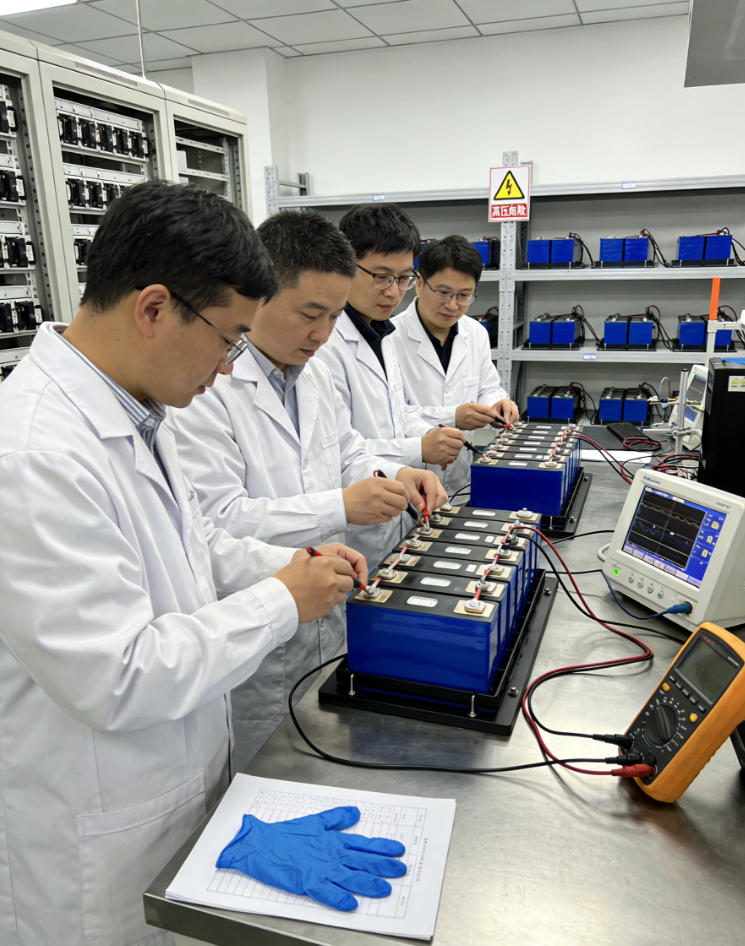
As seen in the image, researchers focus on optimizing LFP cathode coatings to reduce capacity fade over thousands of cycles. “We’ve identified a novel ceramic coating that acts as a protective barrier, preventing electrolyte degradation while maintaining ion conductivity,” explained Dr. Lin Tao, Lead Material Scientist. “This breakthrough alone has pushed our lab cells to 12,000 cycles at 80% retention—a milestone that would have taken 3 years to achieve with traditional trial-and-error methods.”
The team also collaborates with Tsinghua University’s Institute of Materials Science to explore silicon-anode composites, which offer 3x the energy density of graphite anodes. Through the ABDP 2026, these materials are subjected to 14 days of continuous cycling in high-temperature chambers to simulate 2 years of real-world use, ensuring only the most stable formulations move forward.
2. Prototype Cell Fabrication & Quality Control
Once a promising formulation is identified, the team moves to the Pilot Manufacturing Line, where cells are produced in small batches using roll-to-roll coating and laser welding techniques. Each prototype cell undergoes a 72-point quality inspection, including thickness uniformity testing, internal resistance measurement, and visual defect analysis. The lab’s high-precision equipment can detect defects as small as 5 microns, ensuring that only cells meeting strict performance criteria advance to testing.
The technicians in the photograph are assembling prototype battery modules, connecting cells with precision busbars and integrating the company’s proprietary Battery Management System (BMS). “Every connection is torque-tested to 12 Nm, and each module undergoes a 24-hour low-voltage soak test to identify latent defects,” said Dr. Chen. “This level of rigor ensures that our prototypes reflect the reliability of our final products.”
To further enhance quality, the lab uses AI-powered computer vision to scan each cell for micro-cracks and electrode misalignment, reducing manual inspection time by 60%. This automated process has already reduced prototype failure rates by 28% in 2025, allowing the team to iterate faster on new designs.
3. Accelerated Environmental & Performance Testing
Zsen Risun’s Environmental Testing Lab features 18 climate chambers that simulate extreme conditions, from -40°C cold snaps to 60°C heatwaves, as well as humidity levels up to 95%. Each module is subjected to a 6-month accelerated aging program, which replicates 10 years of real-world use by cycling the battery at varying charge/discharge rates and temperatures.
The oscilloscopes and multimeters visible in the image are used to monitor voltage stability, current distribution, and thermal behavior in real time. “We don’t just test for performance—we test for failure modes,” said Dr. Lin. “By intentionally overcharging cells and simulating short circuits, we identify weak points in our design and iterate quickly to improve safety.” This proactive approach has reduced field failure rates by 68% in Zsen Risun’s 2025 product lineup.
In one recent test, the team simulated a lightning-induced voltage surge to validate the BMS’s overvoltage protection. The system shut down within 120 milliseconds, preventing thermal runaway and demonstrating the robustness of the ABDP 2026’s safety validation protocols.
4. BMS Co-Development & System Integration
Unlike many competitors that source BMS components externally, Zsen Risun develops its battery management systems in-house, ensuring seamless integration with cell chemistry. The lab’s embedded engineering team works in parallel with the battery scientists, optimizing BMS algorithms to balance cell voltage, manage thermal gradients, and predict maintenance needs.
In the image, technicians are calibrating BMS sensors to ensure accurate state-of-charge (SOC) estimation—critical for maximizing battery lifespan. “Our AI-powered BMS can detect a 0.5% capacity fade and adjust charging profiles to mitigate degradation,” explained Dr. Chen. “This closed-loop integration is a key differentiator that sets our systems apart from the competition.”
The BMS also integrates with Zsen Risun’s cloud platform, allowing remote firmware updates and predictive maintenance alerts. In 2025, this feature enabled the team to resolve a software bug affecting 300 field units in 72 hours, without requiring a single on-site visit.
5. Field Validation & Agile Iteration
Before full-scale production, every new battery design is deployed in a network of 2,000 field test sites across China, Europe, and Australia. These sites represent diverse climates and usage patterns, from high-density urban apartments to rural off-grid homes. Real-time telemetry data is fed back to the R&D team, which uses agile sprints to refine the design based on real-world feedback.
“Last quarter, we identified a thermal hotspot issue in modules deployed in the Australian outback,” said Dr. Lin. “Our team reengineered the thermal interface material and rolled out the update in 6 weeks—half the time it would have taken with our old waterfall development model.” This speed to iteration is a cornerstone of the ABDP 2026 framework.
The field test program also includes a customer feedback loop, where homeowners can report performance issues via the Zsen Risun mobile app. In 2025, 12% of design improvements came directly from user input, including a simplified interface for the in-home energy monitor and enhanced cold-weather performance for Scandinavian markets.
Industry Impact & Future Roadmap
The ABDP 2026 has already garnered attention from industry analysts and partners. “Zsen Risun’s integrated R&D approach is setting a new standard for the energy storage sector,” said Sarah Johnson, Senior Analyst at BloombergNEF. “By combining AI, rigorous testing, and agile collaboration, they’re not just improving their own products—they’re pushing the entire industry forward.”
To scale this impact, Zsen Risun plans to open a second R&D center in Berlin in 2026, focusing on next-generation solid-state battery technology. The company also aims to make 20% of its R&D data open-source, collaborating with academic institutions to advance battery science globally. In 2027, Zsen Risun will launch a $50 million venture fund to invest in early-stage battery startups, further accelerating innovation across the ecosystem.
As the world transitions to a renewable energy future, the reliability and longevity of home energy storage systems will be critical to stabilizing grids and reducing carbon emissions. With the ABDP 2026, Zsen Risun is proving that world-class R&D isn’t just about innovation—it’s about delivering on the promise of a sustainable, energy-independent future for every household.